You aced (or survived) O-Level English. GP marks differently. This handout shows JC students the clear, repeatable methods that score in Paper 1 and Paper 2, so you stop relying on memorised model answers.

Ms Patricia Koh is a Specialist Educator in GCE O-Level/SEC English Language (1184) and GCE A-Level H1 General Paper (8881) at Stalford Learning Centre. She wrote A-Level General Paper: Comprehension – Mastering Short Questions (1st & 2nd Editions), sold at CPD Singapore and POPULAR Bookstore Online and stocked in several school libraries.
At Stalford Learning Centre, our General Paper teachers don't rely on rote memorisation of model answers. We teach students clear, repeatable methods to read passages accurately, decode exam questions, and plan balanced arguments with confidence.
This handout gives you a sample of those methods. Try each activity as you go. It takes about 15 minutes, and your answers stay on your device.
Many JC students struggle because they treat GP as a brand-new subject. In fact, GP Paper 1 and Paper 2 build directly on skills you already practised in O-Level/SEC English. What changes sharply is how marks are awarded. Compare what you did then with what GP expects now:
Your SEC Discursive and Argumentative writing carries over, but the weighting flips from Language-heavy (20 vs 10) to Content-heavy (30 vs 20). Polished language alone no longer carries the essay. You need real-world current affairs evidence, not personal anecdotes.
Your inference, language-for-effect and summary skills still count. But instead of one passage, you now synthesise three viewpoints, write a summary with no starting line, and evaluate ideas against real-world society in the Application Question.
Not applicable. GP is assessed entirely through Paper 1 and Paper 2.
Arguing a point out loud in SEC Oral trained you to form quick, reasoned viewpoints. GP essays and the Application Question need the same skill, so keep using it.
Key takeaway: You are not starting from zero. Sharpen the question analysis, evidence selection and language analysis you learnt at O-Level, then add GP's demands: content depth, current affairs and evaluation.
Memorising model answers doesn't work because the wording of exam questions changes slightly every year. Strong comprehension comes from three habits:
Both questions refer to the same paragraph and topic. If you write the exact same answer for both, will you get full marks?
Question 1 asks for content: the reasons or ways stated in the text. Question 2 asks for the author's writing strategy: how the author develops or supports the point in that paragraph. Mixing up these two question types is one of the most common ways students lose marks in Paper 2.
Drawn from A-Level General Paper: Comprehension – Mastering Short Questions (2nd Ed.). Tap a question type to see what the examiner expects. The O-Level throwbacks show the habits that carry over into GP.
Many students are told never to copy a single word from the passage. That rule is too rigid and often produces awkward, inaccurate answers. Keeping the passage's exact words is allowed, and necessary, for:
Quick sort: tap each term once to Keep it, twice to Paraphrase it, then check.
Want more guidance? See Ms Patricia Koh's General Paper: Mastering Short Questions (2nd Ed.), or practise these methods with our GP tutors at Stalford Learning Centre.
Suppose a GP passage says:
"Social media algorithms act as an echo chamber, trapping citizens inside a narrow corridor of their own opinions."
Q1 (word-meaning inference): Unpack narrow corridor directly. It suggests citizens see very few diverse viewpoints and are steered along a restricted path of ideas they already agree with.
Q2 (language device and effect): Quote the specific word or phrase, and name the device if you're confident, before explaining its effect. For example: "The author uses the metaphorical phrase 'echo chamber' (or 'narrow corridor') to suggest that algorithms repeatedly amplify users' existing beliefs and restrict them from seeing opposing views."
Misread one word and a well-written essay can go off-topic. Before you brainstorm a single point, break the prompt into three parts:
Define the core subject accurately and don't narrow it too much.
Trap: New Media covers all digital and Internet of Things (IoT) platforms, not just social media apps.
Identify the exact task the question sets.
Examples: To what extent, Discuss, or the difference between Can (possibility/capability) and Should (desirability/obligation).
Spot words that restrict, modify or intensify the claim.
Watch for: never, sole, enough, in your society. Missing one can derail your whole argument.
Pick a highlighter, then tap the words in the prompt to label them.
T: New media (all digital/IoT platforms, not just social media) and unite people (social cohesion, civic solidarity, shared understanding).
D: Discuss: weigh both sides thoroughly and take a clear, reasoned stand.
Q: never is an absolute claim, so even a few strong counter-examples show it is too extreme. enough means measuring actual impact against what is needed. in your society anchors your main examples and evaluation to Singapore.
Students often run out of points after two paragraphs because they think from only one angle, usually personal experience or generic economic points. Structured brainstorming frameworks generate varied, mature arguments quickly:
Best for broad GP essay topics that need 3–4 distinct body paragraphs. Tap a letter.
Best for topics on equality, media representation, demographics or social change. Tap a letter.
Shows how an issue plays out at different scales of society, so you don't repeat the same point.
Want more brainstorming tools? Our GP classes at Stalford Learning Centre cover more thinking frameworks, plus plenty of guided essay practice.
A strong GP Paper 1 essay stands out for clear organisation and sharp evaluation:
Uncover the hidden assumptions behind the question, define key terms where needed, and state a clear stand.
Plan the paragraph order deliberately, e.g. place the Anti-Thesis before the Thesis, or work in Counter-Argument & Rebuttal (the GP version of the Concede-and-Rebut you used for O-Level argumentative essays).
Go beyond basic PEEL. Use Zoom-Out / Zoom-In transitions (linking broad trends to specific real-world evidence), clear analogies, and evaluation that ties back to the question's qualifiers.
End with a thoughtful, forward-looking insight, never a generic cliché.
For each habit, pick the option that best describes you. It shows which skills will give you the fastest improvement.
This handout is a small preview of our full A-Level H1 General Paper programme. Here is how our lessons help JC students improve steadily:
Every SLC GP tutor teaches the same clear, published frameworks (from Mastering Short Questions), so students get concrete tools instead of vague advice like "read more" or "write better", whichever tutor they learn with.
For students losing marks on question interpretation, summary paraphrasing or essay relevance, teachers give step-by-step answering frames, worked examples and targeted feedback on every script.
For students aiming for an A in GP, lessons go deeper into nuanced evaluation, Cross-Passage Synthesis, high-scoring Application Questions (AQ) and mature current affairs analysis.
JC1 students who did well at O-Level often find their grades drop in GP. We rebuild the skills that transfer and add what GP rewards, so the grades come back up before Promos and the A-Levels.
Our team of experienced GP tutors, including Ms Patricia Koh, teaches JC1 and JC2 classes at selected Stalford branches. Class timings vary by outlet, so WhatsApp us for the latest schedule and the branch nearest you.
Message us on WhatsApp to:
Ask which outlets run GP classes and check each outlet's JC1 and JC2 schedule.
Tell us your JC level and goals, and we'll suggest a suitable class, timing and teacher.
Browse our GP lesson worksheets and notes.
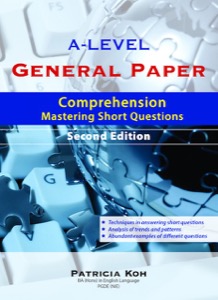
By Ms Patricia Koh. Available at CPD Singapore and POPULAR Bookstore Online.